Thursday, February 25, 2010
We're back
I know I've been away for a bit, but I'm back, and will be posting more regularly. Stay tuned for our take on the new Health Care package being recommended as "The Cure". Talk soon.

Friday, January 1, 2010

Biomechanical X-Rays
Ordinary medical x-rays have become outdated and are not taken today
for anything except broken bones and signs of disease. Many people have
had x-rays taken and heard those famous words, “They’re negative.” Get
enough negatives, and doctors now question the value of the plain film
x-ray. X-rays have clearly lost their sexiness and value.
The more glamorous imaging tests are the MRI, the CT scan, the PET scan, and bone scans. These tests provide information the traditional x-ray does not. Magnetic resonance imaging (MRI) is a test that uses a magnetic field and pulses of radio wave energy to make pictures of organs and structures inside the body. In many cases, the MRI gives different information about structures in the body than can be seen on an X-ray, ultrasound, or computed tomography (CT) scan. The MRI also may show problems that cannot be seen with other imaging methods. A CT scan uses x-rays to make detailed pictures of structures inside of the body, but the amount of radiation used by a CT scan is significantly greater than the radiation used with plain film x-ray. A positron emission tomography (PET) scan is a unique type of imaging test that helps doctors see how the organs and tissues inside your body are actually functioning. A bone scan is a test that helps doctors find damage to bones, like cancer that has spread to the bones, and see problems like infections and trauma to the bones. A bone scan can often reveal a problem days to months earlier than a regular x-ray test.
So, we might ask, where’s the value in the plain film x-ray? It’s simple. We live with a pathology (disease)-based healthcare system. If there is no pathology—no tumor, cancer, or another disease showing on the x-ray film—the “expert” will claim the x-ray is “negative.” What this means is negative for disease or fractures, but not negative for biomechanical (architectural) information.
Because our bodies are biomechanical (architectural) structures, an x-ray, especially one taken with the patient standing, gives a great deal of information regarding that person’s wear and tear patterns and biomechanical imbalances. An x-ray can give a clear status report of where an individual has elevated stress in his skeletal system. There are many predictability factors that we can see when we look at an x-ray from a biomechanical point of view. We can also use the x-ray to rule out pathology. There are many silent diseases and diseases that can mimic basic strain/sprain injuries. The plain film x-ray is the least expensive and simplest screening to use to find such diseases. Finally, the x-ray gives a powerful visual picture of the situation to the patient himself. Successful cases originate when a well educated patient knows and understands what’s happening inside his body.
When we use x-rays as part of the Structural Fingerprint® exam, the number of films taken is dramatically reduced. In a standard medical x-ray series of the neck, for example, five to 11 x-rays can be taken. In the standard medical x-ray series of the low back, five views are typically taken. The Structural Fingerprint® exam begins with only two x-ray views from the front (see Figure 1) and two from the side (see Figure 2). These views minimize the patient’s exposure to radiation while still providing significant information on him. The x-rays also give doctor and patient a starting point for increased biomechanical improvement. Proper treatment and rehab can be recommended based on what these x-rays show.


The normal open-mouth view (see Figure 3) shows key reference points used to determine the status of this patient. The two short vertical lines need to be in line with each other. If they aren’t, the second vertebra, the axis, is misaligned and predictably irritating the spinal cord at that level. The pairs of arrows point to spaces on the left and right sides that should be equal in size. These spaces assure that the two top vertebrae are aligned and the spinal cord receives minimal irritation as it travels to other parts of the body from the brain. Finally, the spine needs to be centered in the open mouth.


The abnormal open-mouth view (see Figure 4) suggests stress and irritation to the supportive soft tissues (tendons and muscles) that are pulling the spine into a distorted position. It also increases the likelihood the nervous system is being irritated at that level. It’s impossible to know exactly what tissues are involved, but these types of imbalances can produce stresses at the highest level of the nervous system, and these stresses predictably will produce an array of symptoms. Symptoms that can be caused by the imbalances seen in Figures 3, 4, and 5 include headaches, neck pain, imbalance issues, digestive disorders, asthma, and allergies. As I tell patients, “Our goal is to get you closer to the norm. We know that will be better for you than what we see in your current state”.


The head, which is approximately 10 percent of body weight, has a great influence on our overall weight distribution and body alignment. While there are established norms for the cervical curve of the neck, known as a lordotic curve, we also see many abnormal findings on x-ray. Let’s begin by looking at a normal side view x-ray (Figure 7). The forward lordotic curve provides shock absorption for the head. The head is approximately 10 percent of the body-weight. The vertical line running through the bones of the neck is the weight-bearing line. This is the center of gravity of the head and verifies that the weight of the head is being supported by the entire neck, not just a few segments of the neck. The disc spaces (indicated by arrows) should be equal in size with each other and basically rectangular in shape.
The abnormal side view of the neck (Figure 8) shows multiple problems. First, the weight-bearing center of gravity line lies in front of the spine, which indicates that the center of gravity of the head is creating significant abnormal stress in the lower half of the neck. Over time, the muscles and joints of the neck will become more and more restricted, which will lead to premature lower joint changes including degeneration. In addition, because the head lies in front of the rest of the body, the entire body must compensate, which can lead to stresses in all supportive muscles, tendons, and joints in the body. This leads to increased vulnerability to injuries and premature breakdown of other muscles, tendons, and joints.


The side view neck x-ray taken at the start of care (see Figure 9) shows a 46-year-old golfer who had to nearly quit playing because of neck and right shoulder pains. Within months, his symptoms improved to the point he was able to play again. The improvement, shown in Figure 10, took the better part of one year.
There are three key questions to ask when viewing the normal x-ray (see Figure 11). First, is the height of the pelvis (indicated by the horizontal line) even on the right and the left? Second, is there alignment between the spine and the joint in the front of the pelvis (the symphysis pubes, indicated by the vertical line)? Third, are the shapes of the obturator foramen (the two holes at bottom of the pelvis) equal in size and shape, suggesting that the pelvis is balanced on both sides? More often than not, one or more of these imbalances will be seen on x-rays, and sometimes, all three imbalances will be present (see Figure 12).


In the normal side view x-ray (see Figure 13), we want to look first at the center of gravity from the side. This horizontal line, better known as the Ferguson’s gravity line, shows if the weight-bearing line in the low back is ahead of, normal, or behind where it should be. We also want to measure the sacral base angle, where normal ranges between 36 and 42 degrees. If the gravity line is ahead of or behind normal, or if the angle is greater than or less than normal, the capacity and tolerance of the low back are reduced and compromised. Typically, an increased sacral base angle accompanies an anterior gravity line, while a reduced sacral base angle accompanies a posterior gravity line. Both are associated with back injuries related to where the abnormal mechanical loading falls.
Finally, we look at the disc spaces. We cannot actually see a disc on an x-ray; what we see is the space it occupies. We can then determine if that space has been compromised. (An MRI is required to determine actual disc status.) If any discs appear narrower than other discs, this is a strong suggestion that the narrower disc joint has lost normal mobility, possible due to abnormal stress through that joint or injury to that joint. The joint that typically narrows first, or degenerates first, is L5, the last joint of the low back. If another joint shows degeneration in the absence of narrowing of the L5 disc space, this suggests there was an injury there some time in the past, and normal mobility was never fully restored.


In the abnormal low back x-ray shown in Figure 14, we see multiple issues that will have a huge impact on this person’s life. First, there is a forward center of gravity line (long vertical line). This line should be going through the short vertical line, but here the body’s center of gravity is significantly in front of where it should be. This lowers the capacity and tolerance of the low back and compromises the functions of the associated muscles and joints.
Second, the sacral base angle is 56 degrees, which makes the angle greater than optimal (36–42 degrees). This also lowers the capacity and tolerance of the low back, making it less functional and more vulnerable to injury.
Case Study #3
It’s not unusual to find abnormal side views of the pelvis and low back (see Figure 15). This patient came into our office with severe and chronic low back pain. With 12 months of proper treatment and rehabilitation, improvements were made (see Figure 16).


Abnormal mechanical loading caused by structural imbalances is a leading cause of joint breakdown. Because our standard healthcare system does not care for the musculoskeletal system, degeneration is seldom prevented. I have no doubt that this negligence condition exists in nearly all people over the age of 50. Abnormal loading leads to fixation of joints, shortening of muscles and tendons, and restricted mobility. When fixation of a joint exists for five to 10 to 15 years, a joint begins to break down and the disc space begins to narrow. There is a roughening of the tops and bottoms of the vertebrae the disc lies between, and the injury progresses.
In the neck, or cervical spine (see Figure 17), the most common joint space to degenerate first is the C5/6 disc space (arrow). Because the C5/6 joint is under the greatest stress in the neck, this joint becomes the most likely to undergo the degeneration process.

In the low back, or lumbar spine (see Figure 18), the joint space that most commonly degenerates first is the L5/S1 disc space (arrow). The L5/S1 joint is under the greatest stress in the low back and is most likely to degenerate.

Many doctors tell us that the degeneration of joints is an old person’s disease. We need to remember, however, that the joints above and below the degenerated joints may be healthy, but they are the same age. “Old person’s disease” is thus a very weak argument. Degeneration is caused by abnormal loading and negligence. It produces major losses in the quality of life and costs us massive amounts of money to treat. Degeneration needs to be addressed long before it begins.
If clinical reasons necessitate x-rays for younger children, the x-rays should be considered.
The more glamorous imaging tests are the MRI, the CT scan, the PET scan, and bone scans. These tests provide information the traditional x-ray does not. Magnetic resonance imaging (MRI) is a test that uses a magnetic field and pulses of radio wave energy to make pictures of organs and structures inside the body. In many cases, the MRI gives different information about structures in the body than can be seen on an X-ray, ultrasound, or computed tomography (CT) scan. The MRI also may show problems that cannot be seen with other imaging methods. A CT scan uses x-rays to make detailed pictures of structures inside of the body, but the amount of radiation used by a CT scan is significantly greater than the radiation used with plain film x-ray. A positron emission tomography (PET) scan is a unique type of imaging test that helps doctors see how the organs and tissues inside your body are actually functioning. A bone scan is a test that helps doctors find damage to bones, like cancer that has spread to the bones, and see problems like infections and trauma to the bones. A bone scan can often reveal a problem days to months earlier than a regular x-ray test.
So, we might ask, where’s the value in the plain film x-ray? It’s simple. We live with a pathology (disease)-based healthcare system. If there is no pathology—no tumor, cancer, or another disease showing on the x-ray film—the “expert” will claim the x-ray is “negative.” What this means is negative for disease or fractures, but not negative for biomechanical (architectural) information.
Because our bodies are biomechanical (architectural) structures, an x-ray, especially one taken with the patient standing, gives a great deal of information regarding that person’s wear and tear patterns and biomechanical imbalances. An x-ray can give a clear status report of where an individual has elevated stress in his skeletal system. There are many predictability factors that we can see when we look at an x-ray from a biomechanical point of view. We can also use the x-ray to rule out pathology. There are many silent diseases and diseases that can mimic basic strain/sprain injuries. The plain film x-ray is the least expensive and simplest screening to use to find such diseases. Finally, the x-ray gives a powerful visual picture of the situation to the patient himself. Successful cases originate when a well educated patient knows and understands what’s happening inside his body.
When we use x-rays as part of the Structural Fingerprint® exam, the number of films taken is dramatically reduced. In a standard medical x-ray series of the neck, for example, five to 11 x-rays can be taken. In the standard medical x-ray series of the low back, five views are typically taken. The Structural Fingerprint® exam begins with only two x-ray views from the front (see Figure 1) and two from the side (see Figure 2). These views minimize the patient’s exposure to radiation while still providing significant information on him. The x-rays also give doctor and patient a starting point for increased biomechanical improvement. Proper treatment and rehab can be recommended based on what these x-rays show.
Front View, Neck (Open-Mouth View)
The front open-mouth view provides much detail, especially with regard to the nervous system and the upper neck. This area of the body is typically involved in many injuries, including sports and automobile whiplashes, and the upper spine has a direct influence over the body’s nervous system, as the spinal cord exits the skull and enters the top two vertebrae, the atlas and axis. Many patients’ chronic headaches are caused by misalignments of these two vertebrae. This x-ray also shows the relationship and alignment of these two vertebrae and the skull.The normal open-mouth view (see Figure 3) shows key reference points used to determine the status of this patient. The two short vertical lines need to be in line with each other. If they aren’t, the second vertebra, the axis, is misaligned and predictably irritating the spinal cord at that level. The pairs of arrows point to spaces on the left and right sides that should be equal in size. These spaces assure that the two top vertebrae are aligned and the spinal cord receives minimal irritation as it travels to other parts of the body from the brain. Finally, the spine needs to be centered in the open mouth.
The abnormal open-mouth view (see Figure 4) suggests stress and irritation to the supportive soft tissues (tendons and muscles) that are pulling the spine into a distorted position. It also increases the likelihood the nervous system is being irritated at that level. It’s impossible to know exactly what tissues are involved, but these types of imbalances can produce stresses at the highest level of the nervous system, and these stresses predictably will produce an array of symptoms. Symptoms that can be caused by the imbalances seen in Figures 3, 4, and 5 include headaches, neck pain, imbalance issues, digestive disorders, asthma, and allergies. As I tell patients, “Our goal is to get you closer to the norm. We know that will be better for you than what we see in your current state”.
Case Study #1
It’s not unusual to find abnormal open-mouth views (see Figure 5) in routine exams. As you can see, there is tremendous imbalance between the spine and the open mouth. There is also an imbalance between the atlas (top vertebra) and the axis (second vertebra). With six months of proper treatment and rehabilitation, however, we see improvements (see Figure 6) in both alignment and balance. The head, which is approximately 10 percent of body weight, has a great influence on our overall weight distribution and body alignment. While there are established norms for the cervical curve of the neck, known as a lordotic curve, we also see many abnormal findings on x-ray. Let’s begin by looking at a normal side view x-ray (Figure 7). The forward lordotic curve provides shock absorption for the head. The head is approximately 10 percent of the body-weight. The vertical line running through the bones of the neck is the weight-bearing line. This is the center of gravity of the head and verifies that the weight of the head is being supported by the entire neck, not just a few segments of the neck. The disc spaces (indicated by arrows) should be equal in size with each other and basically rectangular in shape.
The abnormal side view of the neck (Figure 8) shows multiple problems. First, the weight-bearing center of gravity line lies in front of the spine, which indicates that the center of gravity of the head is creating significant abnormal stress in the lower half of the neck. Over time, the muscles and joints of the neck will become more and more restricted, which will lead to premature lower joint changes including degeneration. In addition, because the head lies in front of the rest of the body, the entire body must compensate, which can lead to stresses in all supportive muscles, tendons, and joints in the body. This leads to increased vulnerability to injuries and premature breakdown of other muscles, tendons, and joints.
Case Study #2
Figure 9 shows the lack of a normal curve and the forward lean of the neck (making the center of gravity sit significantly forward), plus premature wear and tear (degeneration) of the discs (better known as osteoarthritis) in the mid to lower neck. The side view neck x-ray taken at the start of care (see Figure 9) shows a 46-year-old golfer who had to nearly quit playing because of neck and right shoulder pains. Within months, his symptoms improved to the point he was able to play again. The improvement, shown in Figure 10, took the better part of one year.
Front View, Pelvis and Low Back
This view reminds us of the importance of overall balance in our structure. The pelvis can rotate in many different directions and produce imbalances in our pelvis and low back, which means that the correlating muscles on the two sides of the body can be working differently. This will also affect leg length because, more often than not, a short leg is really a rotated pelvis, not a leg that’s shorter than the other. The most important issue is that imbalances in our structures are the precursors to injuries and premature breakdown. This x-ray view can show many breakdowns.There are three key questions to ask when viewing the normal x-ray (see Figure 11). First, is the height of the pelvis (indicated by the horizontal line) even on the right and the left? Second, is there alignment between the spine and the joint in the front of the pelvis (the symphysis pubes, indicated by the vertical line)? Third, are the shapes of the obturator foramen (the two holes at bottom of the pelvis) equal in size and shape, suggesting that the pelvis is balanced on both sides? More often than not, one or more of these imbalances will be seen on x-rays, and sometimes, all three imbalances will be present (see Figure 12).
Side View, Pelvis and Low Back
The side view of the low back can show significant information that will help the doctor predict the capacity, or tolerance, of a person’s low back or the potential for disability over the course of the patient’s lifetime. This view has three key measurements: the center of gravity, the sacral base angle, and the status of the discs. This information, in combination with the other views and tests, becomes the starting point in developing a corrective program for the patient.In the normal side view x-ray (see Figure 13), we want to look first at the center of gravity from the side. This horizontal line, better known as the Ferguson’s gravity line, shows if the weight-bearing line in the low back is ahead of, normal, or behind where it should be. We also want to measure the sacral base angle, where normal ranges between 36 and 42 degrees. If the gravity line is ahead of or behind normal, or if the angle is greater than or less than normal, the capacity and tolerance of the low back are reduced and compromised. Typically, an increased sacral base angle accompanies an anterior gravity line, while a reduced sacral base angle accompanies a posterior gravity line. Both are associated with back injuries related to where the abnormal mechanical loading falls.
Finally, we look at the disc spaces. We cannot actually see a disc on an x-ray; what we see is the space it occupies. We can then determine if that space has been compromised. (An MRI is required to determine actual disc status.) If any discs appear narrower than other discs, this is a strong suggestion that the narrower disc joint has lost normal mobility, possible due to abnormal stress through that joint or injury to that joint. The joint that typically narrows first, or degenerates first, is L5, the last joint of the low back. If another joint shows degeneration in the absence of narrowing of the L5 disc space, this suggests there was an injury there some time in the past, and normal mobility was never fully restored.
In the abnormal low back x-ray shown in Figure 14, we see multiple issues that will have a huge impact on this person’s life. First, there is a forward center of gravity line (long vertical line). This line should be going through the short vertical line, but here the body’s center of gravity is significantly in front of where it should be. This lowers the capacity and tolerance of the low back and compromises the functions of the associated muscles and joints.
Second, the sacral base angle is 56 degrees, which makes the angle greater than optimal (36–42 degrees). This also lowers the capacity and tolerance of the low back, making it less functional and more vulnerable to injury.
Case Study #3
It’s not unusual to find abnormal side views of the pelvis and low back (see Figure 15). This patient came into our office with severe and chronic low back pain. With 12 months of proper treatment and rehabilitation, improvements were made (see Figure 16).
Degeneration (Osteoarthritis) Shown on X-Rays
Abnormal mechanical loading caused by structural imbalances is a leading cause of joint breakdown. Because our standard healthcare system does not care for the musculoskeletal system, degeneration is seldom prevented. I have no doubt that this negligence condition exists in nearly all people over the age of 50. Abnormal loading leads to fixation of joints, shortening of muscles and tendons, and restricted mobility. When fixation of a joint exists for five to 10 to 15 years, a joint begins to break down and the disc space begins to narrow. There is a roughening of the tops and bottoms of the vertebrae the disc lies between, and the injury progresses.
In the neck, or cervical spine (see Figure 17), the most common joint space to degenerate first is the C5/6 disc space (arrow). Because the C5/6 joint is under the greatest stress in the neck, this joint becomes the most likely to undergo the degeneration process.
In the low back, or lumbar spine (see Figure 18), the joint space that most commonly degenerates first is the L5/S1 disc space (arrow). The L5/S1 joint is under the greatest stress in the low back and is most likely to degenerate.
Many doctors tell us that the degeneration of joints is an old person’s disease. We need to remember, however, that the joints above and below the degenerated joints may be healthy, but they are the same age. “Old person’s disease” is thus a very weak argument. Degeneration is caused by abnormal loading and negligence. It produces major losses in the quality of life and costs us massive amounts of money to treat. Degeneration needs to be addressed long before it begins.
How Early Should X-Rays Be Taken?
I recommend that children should receive their first Structural Fingerprint® exam with x-rays at age 12. The arches of the feet are developed by this age and show weakness or strength. The patient’s posture is developed by age 12, and all information is there, ready to be detected. When corrective programs are designed, no one gets results faster than the 12-year-old child.If clinical reasons necessitate x-rays for younger children, the x-rays should be considered.
Thursday, August 6, 2009
Someone must ask "why"?
I just examined and reported to a family about the findings of their 18 year old daughter who is a pretty good runner. She's not run for 2 months, has been in back pain for over a year, and has visited several docs and orthopedists. An MRI revealed 2 bulging discs in her low back with degeneration in the facets (back of each vertebrae). All at 18 years old.
Her treatment is ibuprofen, an over the counter anti-inflammatory. The ortho who recommended it said he now knew the problem (MRI showed bulging discs) and that in most cases, her discs will heal and she only needs the ibuprofen to help reduce inflammation along the way.
The flaw in this story is that no one, at any point, asked "Why does an 18 year old girl have 2 bulging discs in her low back?". If this question were asked, then the biomechanics of the athlete would have to be considered, as the cause of the disc injuries is a biomechanical cause. Unfortunately, most docs out there are totally unfamiliar with biomechanics (norms and abnormals) and therefore, would only show their ignorance if they ever asked the question. Also, in our "I haven't got time for the pain" society we live in, ibuprofen and "it will heal on it's own" is the solution we'd all want to hear.
What disturbs me is, this girl doesn't understand how long life is, and that at her present state, this is the best she'll ever be unless she's willing to begin the process of "fixing" this condition. Which takes work. It takes time. There are ups and downs, but great improvement lies ahead for those willing to fix their problems rather than mask them.
It always goes back to the same thing; our healthcare crisis in this country will never be fixed as long as our healthcare providers stay nearsighted. We need to stop making healthcare a profit industry for many, and make it a guide book to a longer and better life for the individual who wants to participate and be proactive.
When that day arrives, this girl will have a chance at a better and more active future, and the crisis we now know will begin it's long journey back to "healthy".
Thursday, July 9, 2009
My Thoughts...
Modern sportsmedicine ignores the mechanical information that is readily available on all athletes, and prefers to "react" in the treatment of injuries that are largely the result of these mechanical abnormalities.
Unfortunately, this approach is short sighted, as the causes of these injuries are rarely addressed, making a recurrence highly probable.
Tuesday, January 6, 2009
Fixing the Healthcare System
All of us watched as McCain and Obama discussed fixing our healthcare system. Last year, Americans spent more than $2.3 trillion dollars on healthcare. That's more than $7,600. per person.
There recently was a report on the internet that listed 11 ways to slash your healthcare expenses. With great interest, I printed the report out to learn what pearls of wisdom would be listed.
I've wondered if our government can ever spearhead a movement that will actually "fix" the broken healthcare system, as those who are consulting and recommending are actually a big part of the problem. We don't have a broken healthcare system, we have a healthcare system set up for profit, not health.
The laws for health have never changed. Sleep well, eat well, exercise, help others, have good energy and good spirit. Somewhere along the way, pharmaceuticals and crisis care took the steering wheel, and here we are, $2.3 trillion a year.
In order to "fix" the problem, we must rid the roundtable of consultants who are looking for profit rather than solutions. We must promote the "alternatives", such as massage, nutrition, accupuncture, chiropractic, etc. Or any other "effort" that makes sense.
Taking drugs as a primary treatment never makes sense. Drugs should be a last resort. But, the consultants to the "system" write prescriptions. They don't know what the alternatives can do. We need the alternative people to be the consultants. We need the public to get more active and to begin pro-actively getting involved in their health.
The 11 steps to slashing healthcare costs never mentioned anything to do with getting healthier. They all had to do with money and health insurance issues. The answer cannot get away from people getting healthier. We're a country of lazy, comfortable people who don't know the laws of health.
This blog could go on forever. So, I'll stop here, and continue sometime in the near future. Thanks for stopping, and please kick into helping out to change the way business is being done.
Sunday, July 13, 2008
The Journey Continues
Yesterday was the second of our 6 race 5k series with the Capital District YMCA. It was a gorgeous Saturday morning in sleepy Scotia, N.Y., tucked in between the banks of the Mohawk River and the green and chirping of beautiful Collins Park.
We exceeded 100 runners, and for a first time race, and one taking place the day before the famed Boilermaker, this was a great success.
The goal for the YMCA--to get more people active, family oriented and enjoying the beauties around us. The goal for Structural Management® --to raise the awareness of sports biomechanics, and to let everyone know that their life will be influenced by the biomechanical work they do, or don't do. Not only the injuries they will deal with today, but the speed of the degeneration in their bodies in years to come.
I then went to the Induction ceremonies yesterday afternoon of 3 new inductees into the Road Racing Hall of Fame. As an introduction, Larry Rausen called up on stage Nina Kuscik and Katherine Switzer. These 2 women, through persistence and passion, were instrumental in forcing the IOC to ultimately include women's racing into the Olympics, starting with the 1984 women's marathon.
This gives me hope that the mission of Structural Management, as slow as it seems to be moving at times, will one day make sports biomechanics as readily available as pharmaceuticals and surgeries are.
We carry on.
Sunday, April 13, 2008
The YMCA 2008 Race Series
Today, Bill Rodgers and I traveled to 5 YMCA's in Upstate New York to sign autographs (Bill signed) and promote the 5k race series that is coming up. It was great. People loved seeing him, he was as gracious as ever, and everyone had fun. This 5k race series will be a huge success, no doubt.
While Bill was here, visiting from Boston, I'd hoped he could meet my dad, Will Maggs, who continues to work full time at the age of 84. Yes, Bill Rodgers is a legend in this country and has won Boston 4 times and New York 4 times, but I wanted Bill to meet my father more than I wanted my father to meet Bill.
Values, respect, discipline, caring. This is what my father has taught me. Bill, although successful by everyone's standards, has not yet reached the success level of my father. So, it didn't happen this time, but hopefully will happen next time. Bill will be a better person if he gets to know my dad.
And, I'm blessed to call Will my dad. May I do half as much good in my life as he has in his. But, Bill, thanks so much for coming. In time, you, too, will be the best. But, it's because of your love for your daughters in addition to your running. Once they reach a certain age, they, too, will realize what a great dad you've been.
And, once you turn 84, you'll have the priviledge of being the best dad in the world. I'm sure your daughters will agree.
Monday, March 31, 2008
Biomechanical X-Ray Saga Continues
Just as I'm informed by a local insurance company that I should dramatically reduce the frequency of x-rays that we take on patients, I come across 2 magazine articles suggesting just the opposite. Of course, I have such strong feelings on this issue that I don't need the support of these articles, but to hear others endorse my position merely keeps the naysayers off balance.
My position; the industry wants me, and all others, to follow the guidelines of The American Academy of Radiology, which governs what and when to x-ray. The major flaw in this situation is that we, all Drs., are only supposed to take x-rays when we suspect disease. As in pathology. As in bone tumors.
This narrowed vision eliminates all possibilities for x-raying and understanding biomechanical issues. Now, for those who haven't read my work or listened to my message, I'm once again loudly saying, each and every human being has a unique set of biomechanics, and the standing x-ray is the number one tool to determine what those findings are. These findings will allow the trained eye to develop a corrective program, which will then reduce the likelihood of injuries and defer, to some degree, the onset of osteoarthritis.
This would save society billions of dollars. Every year. Not to mention the quality of life. So, you may ask, why isn't it being done? We live with a medical model health care industry, which waits for you to break, only treats the site of injury, and only sets as it's goal the elimination of symptoms. This is like sweeping the dirt under the carpet. Eventually, the floor underneath rots out, and the future is defined.
So, these two other articles talk about why chiropractors are preferred when examinations are done for low back pain, as we look for all kinds of things, and the only way we can look for these all kinds of things is with x-rays. On every patient. The next article writes about a chiropractor who was negligent in the care of a young man, as he never took the necessary x-rays to determine the details of his injury. The case settled for $125,000. prior to the trial.
And these are the two latest endorsements for my proclamation; everyone would do well to be fully examined, including at least 4 standing biomechanical x-rays, at some point in their lifetime. Especially if they want a clearer understanding of what to do to preserve their structure over the course of their future.
That usually includes just about everyone. Thanks.
Sunday, March 16, 2008
Live Internet Radio
Well, week # 1 is in the bank. This show was used more as a test than anything else. We let very few people know we were doing it, just so we could make sure the technical side of it was all working. And, the good news is, it worked.
So, now our goal is to notify as many people as possible about this show, as Structural Management® should also be known as "the solution". There is a total void out there in the sportsmedicine world with regard to good answers for athlete's problems, and we offer much better solutions.
Join in on the show, via e mail or (soon to have) telephone call-in- capability to discuss, question, challenge or whatever moves you. But, regardless of what moves you, join us on Thursdays from 3-4 pm EST, and join in on the movement that is going to transform sportsmedicine world into a new way of doing business.
Stay on the roads, stay in the gyms, stay active, and life will be good. The key is, stay uninjured. With that being said, we know how difficult this can be with our current system.
And, that's why Structural Management® is the solution for the future.
Wednesday, March 5, 2008
Good Job Carl
We have a newspaper columnist in our city who sheriff's everything. As a community member, I know I don't have to worry about a thing, as Carl will keep an eye on teachers, Drs., police, politicians and anyone else who dares to stray from "legitimate". He just seems to catch everyone.
For years now, Carl has focused on the psychotherapy business. He's convinced that new psychological disorders are named for the sole purpose of creating some new (magical) medication to enhance bottom line profits. I'm not a psychotherapist, nor am I familiar with these medications, but I do believe patients are medicated first and talked to only as a last resort. This poor guy gets all kinds of letters blasting him, with justifications being thrown all over the place by those who are in on the take. There are days I really feel for the guy.
So, yesterday, he writes this new article on psychotherapy, a subject he hasn't touched in months with all the police and politician material that's always in abundance. He interviews this woman psychotherapist who opposes the standard protocols of medicating first. She believes in talking to patients. But, the interesting thing is, she describes the current, accepted, traditional system as being "medical model". Yes, this is the standard of care in the medical industry today.
So, I put somewhere on my "to do" list, call Carl. Tell him the psychotherapy industry is not the only profit oriented, ignorant department in medicine. Musculo-skeletal may even be worse. The so-called experts, the medics, and more specifically, the orthopedists, don't really know a whole lot about musculo-skeletal (from a biomechanically diagnostic and rehabilitative perspective). They are great surgeons (most of them), and they sure know how to inject cortisone, but beyond that, they're not much help. Yet, the public believes they are the wise men at the top of the mount.
Next, we have our primaries, who know next to nothing about musculo-skeletal. It's sometimes embarassing when a patient comes in and tells me they went to their primary, and the tests that were(n't) done and the treatment that was recommended. Pills for pain and "stop doing what you're doing" is all too common. Our final players in the game are physical therapists and chiropractors. For the most part, they do very few tests and use the elimination of symptoms as their goal, attempting to get the person feeling better asap....."Quit whining and get back to work".
No one FIXES the person. In psychotherapy or the musculo-skeletal world. I move "Call Carl" higher on my list. Tell him. Let him know our industry is also a profit center (at the expense of humanity) for the pharmaceutical and surgical companies.
As Dr. Bob Arnott says in his book, Wear and Tear, "Our medical profession would have nothing to offer for my sore hip until I needed a hip replacement". And, as the deceased Dr. George Sheehan, famous cardiologist in the running world said, "If you're injured, you'd be better off in the hands of a mechanic than a medical Dr. At least your problem would not be complicated by drugs, that in the end will do no good."
Yes, the medical model probably exists in other departments of medicine. But, being a reader of Carl Strock's column, and living in the biomechanics world, I know there are at least 2 departments in health care that need to burn the current rule book. We need to put the health of the patient back as our number one goal, not the health of some bottom line at the expense of the patient.
Tuesday, February 26, 2008
Life's Lessons
Dr. Robert Jarvik, inventor of the artificial heart, has been removed as pitchman for Lipitor, the best selling medication on the market. According to the report, Pfizer, the manufacturer of Lipitor, felt pressured to make this move as Dr. Jarvik's credentials have recently come under fire.
House Democrats said the ads could be misleading to consumers because Jarvik appeared to be giving medical advice, even though he is not licensed to practice medicine. While Jarvik holds a medical degree, he did not complete the certification requirements to practice medicine.
Democratic Reps. John Dingell and Bart Stupak said Monday the company made the right decision. "When consumers see and hear a doctor endorsing a medication, they expect the doctor is a credible individual with requisite knowledge of the drug," Stupak said.
Too frequently I read articles and get word back from patients how their therapist or health care provider warned them against some of the pro-active efforts we endorse, like flexible custom orthotics, proteolytic enzymes, chiropractic adjustments, cold laser therapy, etc.
I would like to ask Bart Stupak to tell the public that when a Dr., or any other healthcare authority voices an opinion on a possible course of action a patient is going to take, keep in mind this Dr. may not be intimately knowledgable about what they are saying. In fact, more often than not, they have little to no first hand experience regarding what they are saying.
And, as Norman Cousins said in his book, Anatomy of an Illness as Perceived by the Patient, "Be careful who you let make a proclamation of doom on you, as that may be the beginning of the end."
May all experts remain experts only in what they are experts at.
Saturday, February 23, 2008
Shortcomings of Traditional Sportsmedicine
There are 4 basic flaws with today's sportsmedicine industry.
- We wait until an athlete is injured before we do anything.
- We only look at the site of injury.
- Our treatment goals are "to eliminate symptoms".
- We allow insurance guidelines to dictate what care is provided.
- Examine biomechanics prior to season and make corrective recommendations.
- Begin taking corrective measures immediately.
- Never let symptoms be the call to action. The ultimate goal is maximum biomechanical improvements, and once that has been achieved, structural management and maintenance becomes a lifetime mission.
Friday, February 15, 2008
High School Athletes and Scoliosis
This past week, a female high school runner who is a patient of ours came into our office rather upset. She needed to talk. Evidently, the school nurse suggested the possibility of scoliosis, and the very thought of some deformity in her back was overwhelming to her.
Six months ago, when her mother brought her in to go through our Structural Fingerprint Exam® to uncover any structural imbalances or weaknesses, we looked at her in extreme detail to see how she faired. Look at the homepage under "Structural Fingerprint Exam®", and you'll see all the tests we put her through. This was one of those great cases where the mother "gets it", and wanted to have her daughter begin her running career safely, to see if there were any "structural issues" we should know about before she began.
For the past 6 months, we've been treating her accordingly, along with monitoring some of the other recommendations we made for her, and she has succeeded beautifully. She went to Disney in January and ran her first big race, and has continued running since. The joy her mom feels, being a marathoner herself, is, as they say, "priceless".
But, all of these successes became irrelevant, meaningless, as the school nurse examined her and said she might have scoliosis. Tears streamed down her face, and quickly, someone had to try and make sense of it all to her. "The school nurse is using very few tools to examine you, and can only screen you. When seeing so many kids, I'm sure one athlete just blends into the next, and any suggestion is only precautionary".
Within 5 minutes, we had her smiling again, because we pulled out her x-rays, and her spine was as straight as an arrow. "There is no scoliosis", I told her. I also told her I'd be happy to call the nurse and speak with her, which I did.
So, after all that, what is the moral of the story? First of all, from a structural point of view, our healthcare industry grades people as either having scoliosis or not having scoliosis. Black or white. Yet structural biomechanics is hardly black and white. There are unlimited shades of gray, but our medical model healthcare providers are thoroughly unfamiliar with the grays.
They are familiar with hearts and lungs and pancreas', but the percentage of high school kids with issues in these organs pales in comparison to the percentage of kids who have biomechanical issues at this age. The thought that so many kids have braces on their teeth, but their musculo-skeletal system is perfectly balanced is insane.
The second moral of the story is that all high school athletes are examined medically (eyes, ears, nose and throat) while their biomechanics are grossly ignored. This has to change. We know too much now to let these young kids fly without a net in life, when they could easily go through a full exam and begin to make corrections before breakdowns occur.
Like our young runner friend, who clearly can't appreciate how good she really has it. She's paying now so she can pay considerably less later. And, someday, hopefully, she'll appropriately thank her mother.
Tuesday, February 12, 2008
This week's "new pill"
We recently had an article in our local newspaper about a chiropractor using manipulation under anesthesia. He works hand in hand with a radiologist and anesthesiologist in a local hospital, and this was a grand story of patients being "put under" before being aggressively adjusted. All to relieve pain.
As I read the article, I could just feel the enthusiasm in the writer's tone, looking at this as yet another breakthrough in modern medicine. And, the thought that these medical professionals would allow a chiropractor into their sanctuary and work side-by-side with them, almost more than one could bear. Wow, chiropractic must really be excited with such acceptance.
What the story fails to recognize is the lack of foresight and efficiency in our neuro-musculo-skeletal care that is provided to members of our communities. Once again, why does someone get to the point of such chronic, severe pain? The answer is simple; we encourage nothing and provide nothing in the area of management and maintenance of people's structures. Anything proactive, like chiropractic adjustments, massage therapy, physical therapy, custom orthotics, weight management, etc., is only recommended after the fact, never before.
There is a general assumption that everyone is "okay". Their structures are"okay". Ask any M.D. who has x-rays taken on patients backs, and they'll tell you most of them are "negative", meaning, the patient is "okay". But, looking closer, you'll learn the x-ray is negative for pathology, or disease, not biomechanics. Because the truth is, everyone is not okay. In fact, no one is okay. Everyone has biomechanical imbalances and issues. and these issues are the very precursors to structural breakdowns that lead to pain and disability.
So what's the moral of the story? Well, let's first congratulate the chiropractor who is working hand in hand with the medical community. For me, I never want to work in a hospital, as the very thought of that makes me quiver. The moral of the story is that acute, crisis care will always get headlines, as there is no excitement or newsworthiness in maintenance or health. How exciting is someone who doesn't hurt and lives a normal life?
Absence the glory and spotlight, I'll continue my mission to spread the word on Structural Management®, because the more people stay proactive and follow what we're teaching, the less they'll need to hire the "A" team who'll inject, x-ray and manipulate them.
This week's pill.
Friday, February 8, 2008
Void in the system
I had a young high school athlete come into our office yesterday, his mother being an RN, and he was referred by another family we've worked with for years. He had a severe strain/sprain injury of his shoulder, and had been to his pediatrician just the day before. His season is down to 3 games, and he needs to get back asap.
No real tests had been done by the pediatrician, and the recommendations were "rest and ice". Not horrible recommendations, but not "cutting edge"either. After all, no x-rays or other biomechanical tests were performed. So the mom asked me, "What are you going to do?". I told her we'll start by taking some x-rays of his mid-back and neck, to see if there are any underlying causes.
She then wanted to tell me that the pediatricians wouldn't give her a referral to our office and said absolutely don't let her son be adjusted by a chiropractor.
The pediatricians have minimal knowledge of musculo-skeletal injuries, what influencing factors contribute to them, and what corrective therapies, treatments and recommendations are needed to accelerate this athlete back to "game ready" (proven by their exam and recommendations). Yet, they actually believe they're doing right for the patient to make proclamations as they do. And, so many patients accept this.
I'm now working with the Director of all Wellness Programs for the state of New York's state employees. She is an employee of the Department of Health. The DOH has no category for musculo-skeletal. It's not even considered on their list of diseases, conditions, etc. This possilby provides us with the reasons why traditional healthcare only recommends ice and rest. Surely, it doesn't take 12 years of higher education to learn that recommendation. This category has been neglected by main stream medicine, and we're now bringing it to the forefront.
The director and I are now in the process of developing a pilot program, using state employees and Structural Management®, to address this crisis that both industry and sports suffers with (the breakdown of the musculo-skeletal system with no intervening testing or care until after-the-fact). The interest level and acceptance level by all employees, so far, has been extraordinary. Everyone is excited with the possibilities. This void can be filled.
And, if it is filled with a program like Structural Management®, a newsletter will have to be sent out, Express Mail, to all parents of young kids who believe every word their pediatrician says, even if it has to do with conditions they know little about. Parents will need to know there are answers. Better than "ice and rest", which is actually no answer at all.
In 1975, Dr. George Sheehan, the deceased running cardiologist who was a guru in his time, said so eloquently in his Book on Running;
“The human body is a marvelous instrument. When in perfect alignment and balance, there is almost no feat of endurance the body cannot handle even on a regular basis. However, structural imbalance of even minor degrees can result in incapacitating injuries and persistent disabilities.
Prevention and treatment of musculo-skeletal injuries in the athlete, therefore, rests in the establishment of the structural balance and architectural integrity of the body-and its re-establishment should injury occur.
I cannot emphasize too strongly that most athletic injuries are structural, almost architectural, not medical. You would almost be better off in the hands of an engineer than a medical doctor when this type of injury occurs."
The mission continues.
Sunday, February 3, 2008
Broken System
Industry is a perfect controlled study that demonstrates the lunacy in our healthcare system today. Management wants to put the burden of health insurance on the workforce, while the workforce will scream eternally to keep costs on the backs of management. A modern day Hatfields and McCoys.
I've watched over the years, and have never understood why neither side will ever question the healthcare system by asking "Why do you cost so much?". It seems like an appropriate question. "Why have costs escalated so high? When might it stop? And, simply, how can they be lowered?"
This week in Sports Illustrated, this very topic jumps off the pages in Gary Smith's article Bitter Battle For The Old Guard, about Gene Upshaw, the 25 year Executive Director of the Player's Association. The flavor of this article is how retired NFL players are ignored, broken down and no one (The NFL Player's Association) cares.
The article reads, "Creeping along the sideline on a walker, bent at a 45-degree angle, was the alltime great Oilers running back Earl Campbell. Confused by foggy memory, neck locking up from damaged vertebrae, advancing on an artificial left hip was Hall of Fame Dallas Cowboys safety Mel Renfro........How had it come to this?........For three decades, from Pop Warner to retirement, they'd been groomed to spit at the pain, which was ever-increasing as the colliding bodies grew larger and faster, and they'd soldiered on in silence for years after they'd faded away. But then came the day when the consequence of all those head-ons, all that pounding on all that green pavement called astro-turf, demanded its reckoning. The mornings when they awoke and realized they could barely get up......or didn't even want to. The multiple knee and hip replacements, each one carving a year of recovery time out of their lives; the depression, vertigo, Alzheimer's and thoughts of suicide, which some doctors linked to the multiple concussions they'd suffered; the spiraling medical costs and the realization that neither their pension nor their disability plan--if they even qualified for it--could possibly keep pace, had combined to overwhelm them."
Wow. The end result of a broken system. This article wants to highlight the lack of concern the Player's Association has for it's retirees, while I only care to discuss a spoke out of that wheel, the physical condition of retired football players. Their futures have a backdrop of physical disability, pain and limitations, not the type of retirement anyone would aspire to have. The costs are overwhelming; emotional, physical, financial, relationships, employment, etc.
What is the solution? When does it begin? Success in any endeavor requires management. All athletes today, by default, learn the rules in taking care of themselves. Stretch, warm-up, lift weights and hope you don't break down. If you get hurt, well, we're not sure. Do you have a primary? Will they see you today? Or will it be the P.A.? Will they give you meds, a script for phyiscal therapy, a stint of chiropractic? No one really knows. There is no plan other than, we hope you don't get hurt. Maybe just take time off until the pain goes away.
The reason for such inefficiency and ignorance is that our injuries (Earl Campbell bent at a 45-degree angle, Mel Renfro's neck locking up from damaged vertebrae) are biomechanical injuries, yet we MUST deal with medical model healthcare providers. They don't do biomechanics. They don't know biomechanics. Even professional sports teams. And if the pros don't get it, what is the shot that our high school athletes or everyday athletes are going to get it.
Success at maintaining a healthy physical structure also requires management. It starts with a biomechanical exam and detection of the imbalances and faults. Correct those, now maintain these corrections throughout your lifetime. It's not about shots of cortisone, a short stint of physical therapy, surgeries after the injuries occur, early retirement due to broken down parts or retirements that leave you totally disabled.
The current system is broken, and the public must demand change! The answers are available, but don't call your primary and expect them to know. They, too, are victims of the problem. And certainly not the solution. We need biomechanics in our sports world to hope to help the middle and high school athletes of today not end up as a feature story in Sports Illustrated 40 years from now.
The famed comedian Lenny Bruce screamed at the judge as he was being dragged out of the courtroom, "Your honor, somebody needs to tell you when you're screwing up".
Ditto.
http://structuralmanagement.com/CPOYA/docs/highschool1.pdf
Thursday, January 31, 2008
The website
Welcome to our new website. The simple goal of this website is to provide biomechanical information for the masses and make it available to them. We have many, many patients who have been eternally frustrated with their inability to find a Dr. who understood their problem. We gave reasonable and logical recommendations to help them solve their problem. The results are consistently pretty darned good.
Structural Management® is an alternative program for those athletes who are frustrated with the lack of knowledge their current Drs. have. In all honesty, you shouldn't get mad at your Drs. for their lack of knowledge, you should only get mad at your Drs. for not telling you they have no idea why you hurt, and have no clue what to do for it. Pathology based Drs. should readily admit they're unaware of biomechanics, but for some reason, that's not happening.
Well, we're here, and ready, willing and able to help. We'll take you by the hand and walk you through the maze of confusion, as we know the only reason you're even looking for help is that you want to get back to your sport and enjoy all it has to give.
So, bookmark our site, as we'll be bringing some life altering stuff, including case histories, live internet radio, daily stories and more, as our continual goal will be to help you get where you need to be without getting caught up in this healthcare mess that has been created.
Talk soon.
Sunday, January 27, 2008
Injuries
Many have written, and many more will write, asking about injuries and what to do for them. I received a letter this morning, and most of them tell how they've seen chiropractors, orthopedists, physical therapists, etc. Simply put, most of these providers address only the site of injury, while Structural Management® Drs. begin with a full biomechanical exam that we call a Structural Fingerprint Exam® Please read the details on our website, then ask your questions. You'll find your questions are more detailed once you've learned a little bit more about biomechanics and Structural Management®.
Wednesday, August 1, 2007

Sunday, April 1, 2007
Friday, December 1, 2006

Sunday, January 1, 2006
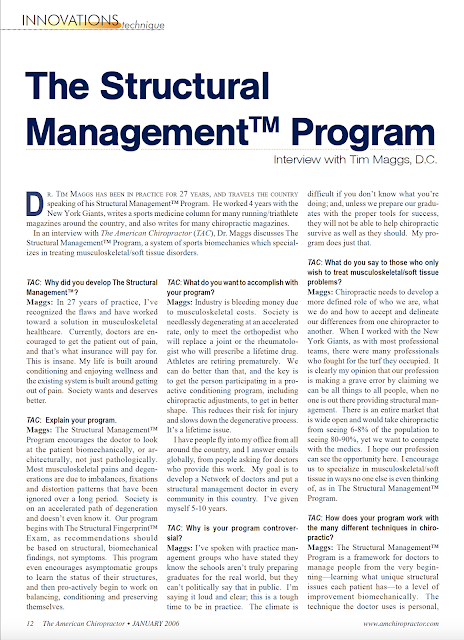
Thursday, December 1, 2005
Orthotics for Everyone?
by Timothy J. Maggs, DCIssue:December 2005
Chiropractic Products
Whether to function under a medical or biomechanical model is your choice
This afternoon, I met with eight-time National Basketball Association all-star Michael Ray Richardson. Michael Ray is taking over the head coaching position of the Continental Basketball Association’s Albany Patroons, while I’ll be providing Structural Management® to the team. In our meeting, I was asked exactly what it is that I do:
“The traditional services provided by a team doctor are to wait until a player is injured, then make the best recommendations possible,” I answered. “That makes no sense, especially when there is a wealth of biomechanical information available on all players right now that will help to determine their unique weaknesses and imbalances. Once we determine each player’s weak spots through our Structural Fingerprint®™ Exam, we can then set up a good proactive program to get all the players doing things that will help their balance, joint mobility, and muscle flexibility. This will dramatically reduce injuries during the year.”
His response was one that every sports-minded chiropractor would love to receive: “I need to set up a meeting with Kiki Vanderweghe and get this program into the Denver Nuggets’ locker room.” Now, for those who don’t know, the Denver Nuggets are a National Basketball Association team, and Kiki Vanderweghe is its general manager.
I can’t imagine any fewer words a chiropractor could say that would get a response as electrifying as that. If chiropractic had the ability to excite key people in sports and industry the same way I happened to in this conversation, we certainly would be in loftier positions in the health care food chain and would be seeing a whole lot more than 6%–8% of the population.
The response from Michael Ray is the same one we get from almost all parties we now meet. The need for Structural Management® is critical, yet it is absent in our modern-day health care system. The medical model is everywhere, despite the fact that everyone would love to learn how to preserve their structures so they can enjoy their lives injury free.
Where to Begin?
I’ve written quite a bit about the need for chiropractors to stop functioning under the medical model of care, especially if we want to fully realize this profession’s potential in our lifetime. Adjustments should not replace pills. Adjustments should be a spoke in the wheel of the necessary tools to keep a person healthier. Our profession truly needs to learn how to articulate this message to our community, because if we do, we will be busier than we have ever wanted to be.
Just last week, I was the guest speaker at a sports information night at one of the larger local high schools. Approximately 800 parents were present. I emphatically told them of the void in good-quality structural care for middle- and high-school athletes in this country. These kids go through medical tests (eyes, ears, nose, and throat) to determine if they are healthy enough to go into the weight rooms and participate in their sports.
The response was overwhelming. I ended the talk telling the parents that their school is now endorsing our Structural Management® Program, and it all begins with our Structural Fingerprint® Exam. This exam consists of a foot exam for foot type; a knee exam for Q angle; range of motion, stressing the key joints of the body; muscle tests, and standing x-rays of the neck and low back. The final test is a digital scan of the feet to determine if the body weight is evenly distributed right versus left. This information is invaluable for determining where the vulnerable and weak spots are on an athlete. We invited parents to fill out an application, and then we would contact them to set up this exam for their children. Within 24 hours, we heard from more than 30 families.
The exams were set up, and the appreciation by the parents was exactly what we’d hoped for. These parents have begged to have someone tell them something that makes sense regarding the injuries their children are suffering. Most of the kids examined have foot imbalances, knee imbalances, and many biomechanical abnormalities that will certainly predispose them to a greater likelihood of injuries, as well as a greater vulnerability to degenerative changes as they age.
How to Use the Test Information
In our office, we offer two products: The Structural Fingerprint® Exam and The Advanced Conditioning™ Program. A patient can purchase either one or both of these programs, but there is no obligation to purchase both. We encourage people to go through the examination, because understanding their structural status is invaluable in many ways, whether they elect to do anything about it or not. Once we have this information, we then design a plan tailored to their needs.
The very beginning of this plan includes the use of custom-made, stabilizing orthotics. Our goal in this program is to improve structural balance, joint mobility, and muscle flexibility. Many doctors use pain and symptoms as their benchmark; however, that superficial goal provides an artificial “correction” to the patient, as most people believe if the pain is gone, they’re healthy.
Most imbalances begin in the feet. We’ve found that approximately 80% of the population pronates (flat foot) with one or both feet. Either way, this produces a postural distortion pattern every time the patient stands up. We’ve also found that 10% of the population has reasonably normal arches, while the final 10% has supinated, or high, arches. This doesn’t take into consideration any of the other biomechanical measurements we look at on our exam, such as Ferguson’s gravity line, the sacral base angle, pelvic balance on the A-P L-S x-ray, femur heights, the cervical lordosis, the atlanto-axial relationship, or the integrity of the disc spaces. Each and every one of these measurements is impacted by the integrity of the medial arches of the feet.
Pronation. This, theoretically, will produce an increased Q angle, but not always. In fact, sometimes we’ll find an increased Q angle with a supinated foot. However, in most cases, the center of gravity going through the knee is abnormal when the medial arch pronates. The human body is a compensating architectural structure, and pronation begins the very “shifts” that accelerate wear and tear at many levels of the structure. Custom-made orthotics begin the balancing process that all structures need to go through.
Normal arches. Many doctors think this is a ticket for dismissing a patient, as “nothing is wrong.” Au contraire. Keep in mind that this patient, if he or she is lucky enough, will go through the aging process, and two factors will influence his or her future.
The first factor is that medial arches of the feet weaken and fall as time goes on. When patients tell you their feet are growing, keep in mind that their medial arches are simply falling. As they fall, the biomechanics of the structure will go through negative changes. Imbalances accelerate degenerative changes, and falling arches will only pour fuel on that fire. Why wait for that to happen? Purchasing custom-made, stabilizing orthotics is a nominal fee to protect against this, and people are desperately looking for this information.
Second, the shock-absorbing qualities of the orthotic reduce the wear and tear going up through the structure. Over the course of one’s lifetime, this is huge.
Supination. These high, rigid arches have very little shock absorption for the structure. It becomes critically important to incorporate some shock absorption into shoes to protect against the acceleration of degenerative changes, and addressing this issue on the front end is always more cost-efficient and logical than addressing it on the back end.
Regardless of foot type, custom-made, stabilizing orthotics are the very beginning of the preservation process of everyone’s structure. The key is for the doctor to learn how to articulate this message to all patients, despite the fact that insurance will seldom cover the cost of the orthotic. Ninety-five percent of all patients in our office are fitted with custom-made orthotics as part of their program, and our area economically is no better off than most other areas in the country. It’s purely a matter of confidence and desire on the part of the doctor as to how much they’re willing to help the patient over the course of his or her lifetime.
Many chiropractors want to argue the fact that our profession should function under medical-model guidelines. Certainly, that system is already in place and available if those are your parameters. However, another “pain reliever” who wears a stethoscope around his or her neck is not what the world needs. Industry, sports, pediatrics, and geriatrics are all begging for someone, anyone, to teach them how to preserve their structures and protect against injuries. The medical-model approach will never be able to do that.
Structural Management® is the key; custom-made, stabilizing orthotics are a tool; and chiropractors are the most qualified to provide this level of care. It’s all about choice and how you want to help your community. And, should I meet with the Denver Nuggets’ Vanderweghe, this may be the entry into pro sports that will provide many more chiropractors with respected roles in pro organizations. CP
Timothy J. Maggs, DC, specializes in sports and industrial injury management and is a graduate of the National College of Chiropractic. He writes and speaks at numerous engagements.
Tuesday, November 1, 2005
Improving the Chiropractic Posture
by Timothy J. Maggs, DCIssue:November 2005
Chiropractic Products
We need to do the proper testing, make the proper recommendations, and be willing to manage the patient to a higher level of health
Some 20 years ago, I enjoyed a book titled, “Winning Through Intimidation,” by Robert J. Ringer. Ringer was a realtor who faced many tough experiences in his quest for success.
He was never told about closings from which he should have received a commission; he would receive a pittance of the commission he thought he would receive; and he was always treated with little respect when he tried to carve out a place for himself at the table of life. If I didn’t know better, I might have thought Ringer was a chiropractor.
Ringer did the unthinkable: He enhanced and improved his posture. He developed a business card the size of a birthday card. On the front was a picture of the Earth. Each card cost $5, and that was back in the 1970s, but he figured it was worth it, as this started the process of people treating him with more respect.
He then decided that ultimate posture could be attained if he, too, had a lawyer representing him at closings. It was his position that an unwritten “lawyer-to-lawyer code” said they would never, under any circumstances, disrespect each other in any business matter. So, at each and every meeting and closing, Ringer would show up with a lawyer.
Finally, when money started coming in the way it was supposed to, Ringer purchased a private jet to travel to and from projects from afar, never missing even the smallest meeting. He would transport buyers and sellers, and represent himself as the key person in all of his transactions. In essence, he wanted everyone to see him as indispensable and absolutely necessary for any sale to take place. Once he achieved this, commissions became an afterthought.
The Posture of Chiropractic
Needless to say, the state of chiropractic can be directly measured by the 6%–8% of the US population that uses chiropractic. Simply put, this is just unacceptable. However, if chiropractic is to ever grow from this point, we need to be brutally honest as to why we have not grown during the past decades.Yes, we can all agree we have much going against us. In this country, we live in a medical-model system. Whoever can provide the best and quickest pain relief is going to make the most money. Even though this is the lowest standard of care any human can ask for, this is the way it is. Patient expectations, poor insurance reimbursements, and medical marketing and advertising make it very difficult to change the way the system works. We all graduated with the hope we would help correct the cause of problems, but once in practice, we soon realized that if we enjoy the art of eating, we had better defer to the system that exists out there. And, slowly, we became people we didn’t like, respect, or understand. We’re reduced to marketing our adjustment as a better and quicker way to relieve pain. Oh, my.
So, when we talk posture, it becomes extremely difficult to walk tall, act authoritatively, and pretend that we are the “experts” when it’s hard to even get paid for what we do. But, posture is the key to it all, and somehow, the profession needs to redesign its postural profile to reach newer and higher levels. How and where does that start?
Improving the Chiropractic Posture
The first step in improving our posture is to clearly define who we are and what we do. With a clearer definition, it becomes easier to recognize who our market is and the value we bring to this market. We can’t hope that our community will fully understand who we are and what our product is all about using only the previous knowledge they’ve learned. Much of that knowledge is incorrect or learned through inappropriate sources.We must rewrite the information our community is getting, and it all begins with us defining more clearly who we are and what we do. Once our value is better recognized, then we just need to get the message out there. With the improved response we get from members in our community, we will feed our inner selves, making our belief system grow even stronger.
In chiropractic, we have created many subspecialties. This subspecialty idea will help dictate who our market should be and what our job description is. We need to simplify the definition of who we are and what we do. If we can’t tell it in three lines or less and make an impact, then we will never get the public to understand. The people in our market are going 100 miles an hour in life and are constantly bombarded with advertising and marketing stimuli from all directions. We need to be clear and simple.
For example, in my particular case, I specialize in Structural Management®. My goals are to:
help people get a status report of their structure (Structural Fingerprint®™ exam);
develop a proactive “plan” that is based on much more than symptoms (much like the orthodontist) for them to biomechanically improve to their maximum level (our Advanced Conditioning™ Program), which will reduce the vulnerability of injury; slow down the degeneration process (wear and tear or rotting); and improve structural balance, joint mobility, and muscle flexibility; and
help people manage that improvement for the rest of their lives.
With this simple explanation, most people are intrigued, as no one has ever suggested to them that they can delay degeneration. No one has ever suggested that a “plan” can be created just for them. Most people are interested because this message is not based on symptoms, crisis/pain management, or surgery. It is based on universal information—imbalances increase the likelihood of injury and accelerate the degenerative process. A statement like this will move people to consider your care.
Next, we need to raise the level of responsibility to the patient. Much of health care today is increasing liability protection at the expense of good will or helping the patient. And the public feels this separation every day. A profession with the courage to increase the responsibility—similar to the doctors of yesterday—will inevitably be viewed with much greater respect.
We need to do the proper testing, make the proper recommendations, and be willing to painstakingly manage the patient to a higher level of health. The current system is a superficial, test-oriented, symptom-relief system, and this will help no society have a better future. This superficial help also will minimize the quality and depth of a relationship between a doctor and his patient.
Proper Testing
We must be aware of the pain, and care about the pain, but look beyond the pain. In my office, we want people to come in when they are asymptomatic, as full physical testing can be done then. If the patient is in pain, we need to rule out pathology and start him on a pain-relief program. We never know how long that will take, but the patient understands that, when the pain is improved, we will determine what corrective program is necessary.To rule out pathology, determine biomechanical faults, and show patients what their problems are, standing x-rays are mandatory. This information cannot be determined without them. If a correct explanation is given to the patient, rare is the patient who will not go through this testing. To let a patient talk a doctor out of taking x-rays adds to our weak posture.
Full structural testing should complement the x-rays. These tests include foot type, Q angle, joint range of motion, leg lengths, muscle strength and compliance, nerve testing, and any other tests a doctor feels is necessary. But the bottom line is, any treatment given without doing the preliminary testing will only add to our weakness.
Making Proper Recommendations
Most people in this country have never gone through a complete biomechanical exam; therefore, they live in a state of deferred maintenance. Chiropractors have slipped into the category of making a subluxation a pathology, and our goal, unfortunately, is to remove this pathology. However, it doesn’t take much intelligence to know that a subluxation at T12–L1 is always directly influenced by any abnormality in the arches of the feet. If we do not correct the imbalance in the feet, this architectural structure will never have a corrected T12–L1 motor unit.Therefore, custom-made orthotics are mandatory for long-term wellness of this patient. What I’ve come to learn is that just about every patient who comes to my office has multiple foot, knee, hip, low-back, midback or upper-back imbalances that will be directly improved with the addition of custom orthotics to their “plan”—especially over the patient’s lifetime. In fact, 95% of all patients in my office are fitted with custom-made orthotics at the beginning of their plan.
Also, time is a crucial component of biomechanical improvement. If an orthodontist needs 3 years to help improve the alignment of a 12-year-old’s teeth (despite the fact there are no movable joints, and the teeth are not weight-bearing), then how on earth can we hope to improve overall balance, joint mobility, and muscle flexibility on 12 visits per year? The answer is, we can’t.
So our posture in the community goes way up when we begin recommending something that makes sense. A conditioning program that includes spinal adjustments, extremity adjustments, rehabilitative exercises, custom-made orthotics, weight management, nutritional supplements, and whatever else is needed will always make patients feel as though they are going to “the best.” Six months is the minimum time frame any of us should ever recommend to a patient for corrective care.
I know that conditioning is the only way to prepare for a marathon. The thought that someone will get their back to function better—especially when we know the aging process is a detrimental contributing factor—without getting in better shape is absurd. Time is mandatory for any level of improved conditioning.
Managing the Patient
This skill requires confidence, communication, management skills, problem-solving skills, and true concern for the long-term wellness of the patient. Our profession would do well to provide these ongoing courses to all chiropractors, as this is what the public is looking for. Our posture will dramatically improve when we improve in these categories.When I tell patients something they don’t want to hear (such as telling them they’re not doing a good job at keeping their appointments), and that if they don’t improve they can’t expect the best results, this tells patients I’m not out to just be their friend; I’m out for their well-being. This is what patients want and need.
There is much room for posture improvement in our profession. We need to focus more on the above issues than on improved clinical knowledge, as the art and science of chiropractic that we all learned is more than enough to make you the best doctor in your community. However, we need to spend much more time on becoming better healers, so we can learn better how to relate to and answer the many needs of an ailing public. CP
Timothy J. Maggs, DC, specializes in sports and industrial injury management and is a graduate of the National College of Chiropractic. He writes and speaks at numerous engagements.
Subscribe to:
Posts (Atom)